
 History of Kanban
Over 50 years ago Kanban was invented by Taichi Ohno at Toyota. Kanban is Japanese for “Signboard” or “Billboard”. In the late 1940s, Toyota found a better process from an unlikely source: the supermarket, they noticed that store clerks restocked a grocery item by their store’s inventory, not by their vendor’s supply.Only when an item was nearly sold out did the store clerks order more. The grocers’ delivery process inspired Toyota engineers to rethink their methods and follow a new approach—a Kanban system—that would match inventory with demand and achieve higher levels of quality.
A new application of Kanban emerged for knowledge work as early as 2005, and an inquisitive community formed in 2007 around the leadership of David J. Anderson, Jim Benson, Corey Ladas and others. The resulting body of knowledge was influenced not only by the Toyota Production System but also by the work of W. Edwards Deming, Eliyahu Goldratt, Donald Reinertsen and other thought leaders.
KANBAN PRINCIPLES
Visualize the work : You can’t understand what you cant see. Making the work visible by creating a visual board of work to be done, issues and queues instantly leads to improvement in process and communication.
Work- in- process (WIP) Limits : Kanban is a great way to get the work done systematically. The best way to get more work done is to avoid multitasking as it takes more time to work on multiple things in parallel than to concentrate on just one task at a time.
Manage work flow : By Enhancing the way you work can make you more efficient.
Making process policies explicit : Take continuous feedback from the team on how you want to manage the kanban.
Collaborative Improvement : Changes made Collaboratively as per the process can help in improving the team’s effectiveness.
KANBAN BOARDS :
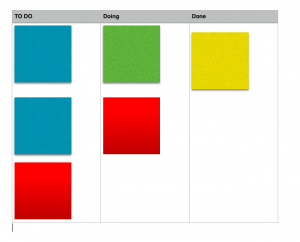
A Kanban board is a work and workflow visualization tool that enables you to optimize the work flow. Kanban boards can be physical or virtual. Virtual boards are helpful for the teams at different locations. A basic Kanban board comprise of TO-do , In progress and done. Below is an example of Kanban board :
Kanban vs Scrum
Kanban needn’t have defined roles where as all the roles are defines in scrum, the scrum master, product owner they are well aware of there roles and responsibilities.
Kanban has continued delivery where as in scrum work must be completed and delivered at the end of each sprint.
Kanban uses Pull system. Once the task is completed the work flow allows the team member to pull a new task. Scrum also uses Pull system however only after each iteration.
Kanban allows Modifications in midstream where as in scrum it is highly discouraged.
Kanban measures productivity by using cycle time that is the count of time taken to complete the project from start to end whereas in Scrum the productivity is measured using velocity throughout the sprint.
Kanban is used best in the projects where the priorities keep changing. Scrum is best used for team with stable priorities.